


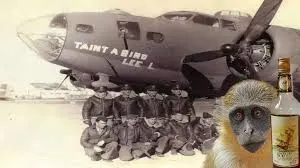
The Rum-Loving Monkey Who Crash-Landed in a B-17
World War II is one that is marked with great battles, heroic sacrifices and technological advances that would forever alter the course of history. But among the famous tales of bombers, pilots, and air attacks there is one strange and memorable legend about the war, the rum-loving monkey that crashed into a B-17 in WW2. It is a weird but thrilling story that combines the history of the aviation during the war, humor, humanity and the unpredictable friendship with the most dangerous situations.
It may sound strange, but it is true, and the story has survived decades as one of the greatest anecdotes in the skies of the World War II.
The B-17 Flying Fortress and the World War II.
In order to appreciate the story of the rum-sucking monkey who crash landed in a B-17 during WW2, one will first need to be aware of the aircraft in question. One of the most famous war-time bombers was the Boeing B-17 Flying Fortress. The B-17 was used widely by the United States Army Air Forces and was intended to be used in long distance strategic bombing missions against Europe.


The B-17 survived the fire of the enemy, earning it the name, which was heavy armed with machine guns and able to fly on the high altitudes. Mission on these planes was however very dangerous. Anti aircraft guns, ground enemy fighters, mechanical breakdowns, freezing weather and hours of constant strain were adversaries of the crews. The Rum-Loving Monkey Who Crash-Landed in a B-17
Nowhere in full of this gorgeous truth was morale wanting and, in some instances, it was supplied by the most unanticipated quarters.
Wartime with animals: More frequent than you think.
Animals have been used in war since time immemorial. Since war horses and messenger pigeons, dogs which could be trained to detect and rescue even the people on the battlefield have been used since time immemorial with the soldiers. Mascots were also common in the military units especially during World War II.
These mascots provided solace, amusement and a feeling of sanity in a chaotic world. The units kept dogs, cats, birds and even bears. It is in this culture that the rum drinking monkey who had crash landed in a B-17 fighter during WW2 was an unlikely aviation legend.
Meet the Monkey: A Mascot of the Unusual Type.
The monkey in the center of this tale was according to reports purchased by the Allied airmen when they were on duty abroad. Europe did not have monkeys but soldiers came across exotic animals during their military service in the African, Middle East, or Asian continent.
This monkey became famous rather soon due to its mischievous nature and its love of alcohol, namely rum. Rum rations were not a new idea at the time in military environments and the monkey became fond of it to a great deal of amusement of the crew.
The monkey was no longer a mere mascot soon. They grew a part of the crew, and when the morale was at its lowest ebb, they provided some laughs.
How the Monkey Ended Up on a B-17
The events leading to the crashing of the monkey who is the rum-loving monkey and the B-17 plane crash in WW2 are as much of a surprise as the story itself. The monkey was in a mission, during one of its missions, or maybe during a transfer flight, the monkey was allowed to fly on the aircraft.
Although B-17s were not equipped to transport animals, in some cases, it was done, particularly when there was no combat. The crew, who loved their odd friend, never even thought that their journey would become a threat to their lives.
Disaster in the Skies
The B-17 had a serious trouble during the flight. It is alleged that mechanical failure or a fire on the part of the enemy pushed the plane into an emergency. The bomber lost altitude and the crew was wracking to retain its control.
Eventually, the airplane crashed. Although the crashes involving B-17s had a high mortality rate, it was survivable. Nobody was killed as the crew, together with their improbable passenger, survived the ordeal.
Amid the debris and mess came one of the most incredible survivors of the history of aviation in World War II the rum-loving monkey who had landed in a B-17 in WW2.


The Mythical Act of the Monkey after the Crash.
In addition to the fact that it was a miracle that the monkey survived the plane crash, his subsequent actions made the creature even more legendary. On witness report the monkey came out of the ruins stunned and still alive-and said to have been still in need of rum.
The monkey not only gave the rest of the scared crew hope but was also an immediate tale of the rest of the airmen. Such absurdity and survival were a relief of emotions in the environment where death was a normal occurrence.
Why This Story Matters
The story of the drunken monkey landing in a B-17 in WW2 might seem at first glance, but it is merely a comic incident in history. It however speaks of more about the reality of wartime life.
Soldiers and airmen were left at a young age, were homesick and in the face of death at all times. Mascots, and most particularly bizarre ones, served to redeem humanism. The monkey was a symbol of strength, friendship, and laughter which is necessary even during the most desperate moments.
Life Aboard a B-17: Stress, Fear, and Camaraderie.
Being a pilot in a B-17 was a very hazardous task in the war. Crewmen worked in the freezing conditions and wearing the oxygen mask during hours. Bomber crews were being killed in large numbers.
In this pressure cooker setting, relationships were created in a short period of time. The crews depended entirely on one another. Such bonds were made more strong by having a mascot such as the monkey which would serve to give the missions a laugh break.
The very survival of the rum loving monkey who landed in a crash in a B-17 during WW2 became symbolic of that common strength.
Out of War Crime to Heritage of the Years.
Such stories as that had a tendency to be transmitted by word of mouth. Veterans exchanged them on reunions or in memoirs or with family members. The story of the monkey became a legend as time went by, yet the facts about it were certainly left the same.
The story remains an example of the peculiarities of wartime service that historians and aviation enthusiasts still use today. It goes with other bizarre yet true tales of the World War II that help us to remember that history is not all about strategy and politics but about people (and sometimes about animals).
Animals and Alcohol: A War Curiosity.
The fact that the monkey enjoyed rum may be an eye-opener in the present day, yet, in the times of World War II, it was a normal practice to use alcohol as a calming agent or even to mark a victory. Animals which were subjected to these environments ended up doing things like human beings.
Modern conventions would not allow such practices, but the novel is based on another period, which was marked by poverty and improvisation. The antics of the monkey were seen as harmless entertainment during the times when there was little to laugh at.
What Befell the Monkey after the War?
There is less clarity regarding what happened to the monkey in the end. It is said to have stayed with the military until the war ended, but it is thought that some were taken up by the locals or they went back to a zoo.
No matter where it was going, the rum-loving monkey that crashed down in a B-17 during the WW2 made a very memorable impression on the people who saw it miraculously survive.
The Reason People Continue to Love this Story.
This story has remained in the imagination of people decades later. It is a mixture of aviation history, animal companionship, and survival against all odds.


At the time when writing about the war is driven to statistics, this story makes us remember about the human and emotional aspect of a war. It emphasizes the fact that even during the time of the war, there are moments of happiness, absurdity, and bonding.
Saving Strange World War II Memoirs.
The further the World War II becomes a part of the past, the more significant it becomes to preserve such stories. They introduce reality and human face to what has been written in history such that the war will be remembered not only because of its devastation but also because of its survivors.
The myth of the alcohol drinking monkey, that crashed in a B-17 in the WW2, makes our awareness of the past more interesting than most conventional stories do.
Conclusion
Among the oddest, most heart-felt, and most human stories to come out of the World War II period is the tale of the rum-loving monkey who crashed in a B-17. It also has the effect of reminding us that despite destruction, life washes in to delight us.
Courage, camaraderie, and a monkey with a taste to rum, have made this remarkable event part of history, and it is now proved that not all war heroes put on uniforms, and not all survivors are human beings.