


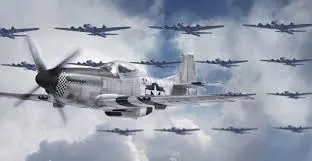
Lone unidentified Mustang pilot
Historical accounts of heroism are abundant in the history of World War II aviation, but some tales lie in the periphery of the history– half legend, half testimony. One of these reports tells of a single unknown pilot of a Mustang who supposedly waited as many as 30 enemy fighters before they could assault a group of defenseless B-17 Flying Fortress bombers.
This dramatic account has been spread through the memories of veterans, history of aviation and military hobbyists over the decades. Although concrete records are still elusive, the story provokes some key issues regarding the aerial warfare, escorts, the skill of pilots, and the creation of the legacies of war. The article discusses the historical background, the plane, the tactical viability, the evidence that exists and the long-term meaning of this remarkable statement. lone unidentified Mustang pilot


The Strategic Environment: The Reason B-17s Have to have Escort Protection.
Daylight Bombing Over Europe.
Precision bombing was extensively used by the U.S. Army Air Forces (USAAF) in the course of World War II, which mainly used daylight. The main focus of this plan was B-17 Flying Fortresses that were to bomb industrial and military targets of the enemy in the inner territories. lone unidentified Mustang pilot
B-17 formations were however very susceptible to interception by fighters particularly prior to the long range escort fighters. In the initial war, the casualties of bombers were devastating, and a re-evaluation of the strategy was needed.
Enter the P-51 Mustang
The air war in Europe changed after the North American P-51 Mustang was introduced. The Mustang was long range, high speed, very maneuverable and lethally armed to provide American fighters with the ability to escort bombers to targets such as Berlin- and beyond.
The P-51 had several major strengths such as:
Drop tanks with a range of over 1,600 miles.
Outstanding high-altitude operation.
Six .50-caliber machine guns
Outmaneuvering capability to match with the majority of Luftwaffe aircraft.
This airplane opened up stories such as the one about the unknown Mustang pilot flying on his own made possible, at least in theory, though it was still incredible. lone unidentified Mustang pilot
The Alleged Incident: What The Story Telleth.
As it was recounted in several retellings, the incident happened at the end of the European air campaign, probably at the end of 1944 or in early 1945. The main components of the narration are similar in all the versions:
A force of B-17 bombers had come back to a mission in Germany.
Their fighter guard had been emptied or turned aside.
A huge group of about 30 enemy warriors came near.
One P-51 Mustang came in the picture and fiercely competed with the aggressors.
The Mustang fighter moved in circles, destroying assaults.
More than 30 minutes of enemy fighters disengaging.
The pilot had not been found.
There are no verified kill numbers that are linked to the incident; the point is disruption, but not destruction.


Tactical Analysis: Can a single Mustang Defend 30 fighters?
Combat Doctrine vs Reality
Theoretically, a single combatant is not able to kill 30 enemies on a one-on-one basis. But aerial fighting is not all about figures. A single Mustang might be able to slow down or disrupt a much larger force as a result of a few factors:
Aggressive positioning: There are regular high speed passes based on which there can be no coordinated attacks.
Psychological pressure: An attacker who is not afraid might seem to be backed by invisible supporters.
Power advantage: Excellent altitude and speed may determine the terms of engagement.
Defensive priority: Escort fighters were aimed at disruption, not killing.
Only one unknown Mustang pilot would not have to demolish all the attackers, just ensure that they cannot make effective attack formation against the bombers. lone unidentified Mustang pilot
Luftwaffe Disadvantaged Towards the end of the War.
Towards the end of 1944 the position of the Luftwaffe was extremely difficult:
Experienced pilots shortages.
Fuel rationing
Poor command and control.
Decreased morale
Enemy pilots who ran into an incessantly violent Mustang could well have assumed that there were other escorts in the air, and acted sensibly rather than decisively. lone unidentified Mustang pilot
Eyewitness Testimonies and Oral History.
Bomber Crew Testimonies
Some anecdotal reports by crew members in the B-17s state that a single escort fighters came when it needed most. They were sometimes told in an informal way after the mission was complete or written down several years later with interviews and memoirs.
However, bomber crews:
Was poor in sight beyond their group.
Prone to being misjudged on the size of the enemy.
Unable to follow individual fighters throughout the time.
Although these are good accounts they should be taken with caution.
The Problem of the Finding of the Pilot.
Records keeping although extensive in World War II was not flawless. The complicating factors include:
Chaotic combat conditions
Aircraft misidentification
Lost or missing mission logs.
Emergency landings or diversion.
Had the pilot parted ways with his unit, or was short of gas, or on his own, his actions might have never been documented at all. lone unidentified Mustang pilot
Why the Story Endures
The myth of the unknown Mustang fighter man remains alive due to the fact it is more than some statistics or proved wins.
Personal Courage as a Symbolism.
The world war two is the one narrated in bulk numbers-divisions, fleets and even in numbers of casualties. Such stories put the narrative back to an individual agency and remind us that individual choices and acts of heroism can have a difference. lone unidentified Mustang pilot
The Escort Mission Ethos
Fighter pilots were trained to give protection to bombers at any cost. Most Mustang aces were keen to point out that their main responsibility was not to kill but to get bombers back safely.
This novel is a classic text of such ethos: sacrifice, discipline, and undying devotion.


Similar Historical Events.
Although this event in particular cannot be confirmed, there are other comparable recorded actions that prove its possibility.
Recalled Unescorted or Outnumbered Fights.
RAF pilots who were behind schedule in holding off German raids in the battle of Britain.
USAAF pilots flying bombers in pursuit of their wingmen.
Luftwaffe heroes who held formations under a huge fire.
These examples show that a high numerical imbalance was not necessarily a failure.
The Myth vs History: The Creation of Legends.
The Character of Wartime Storytelling.
Legends often emerge when:
Observations are made and things are not properly recorded.
The participants live but fail to recognize some important people.
There is a retelling of stories between generations.
With time, the details can become sharper as opposed to blurred particularly when the central reality is emotionally charged. lone unidentified Mustang pilot
Does Falsehood Implicate Lack of Proof?
Not necessarily. Lack of documentation does not correspond to lack of happening- especially in war circumstances. Historians should however strike a balance between respect of testimony and high standards of evidence.
The story of the single unknown pilot of the Mustang falls in this gray area: it is possible, convincing, and unverified. lone unidentified Mustang pilot
Even in the absence of confirmation, it is important historically.
The value of the story, whether literal or symbolic, has a historical value.
Educations to the Contemporary Audience.
Personal behavior is important, even in huge systems.
Even when not acknowledged, courage can change the course of things.
There are voices and events in history that are not documented.
The fact that the pilot was anonymous gives the notion that there were an infinite number of heroic efforts that were never documented. lone unidentified Mustang pilot
The Reason Why the Mustang is Important in this Story.
P-51 Mustang was particularly well adapted to such a part:
Quickness to get and get out.
Sufficient firepower to ward off attacks.
Granting unforeseen manifestations.
The plane itself turned into an icon of Air superiority by the Allies, and this narrative enhances that legacy.


Conclusion: In Memoriam: Nameless Defender.
The story of an unknown pilot in a single Mustang defending against 30 hostile aircraft more than 30 minutes might be never confirmed. Nevertheless, it survives since it is in line with what we are aware of the aircraft, the pilots, and the harshness of the World War II air warfare.
Whether it is intimate reality, fictionalized memory, or symbolic truth, the tale is a tribute to the untold multitude of fighter pilots that flew escort missions considering that what they were doing was protection, not glory. They were never awarded medals, headlines, or recognition many times but their deeds saved lives.
The anonymity of the pilot is appropriate after all. He does not symbolize a single man but a generation of aviators whose daring has defined the history of the sky one man alone, one unrecorded, and at all times, under tremendous danger.