


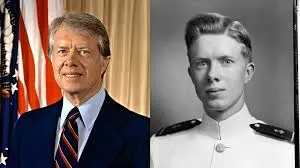
Jimmy Carter US Navy Service White House
The Jimmy Carter US Navy service White House career story can tell how a military experience could make one of the most unusual presidents in the history of America. Prior to entering politics, which later saw him become a president in 1976, James Earl Carter Jr. was a dedicated naval officer serving seven years on surface ships, and developing the nuclear submarine program in America. The legacy created in the Jimmy Carter years of the US Navy service in the White House was reflected in his leadership style, decision making and service that characterized his political career and post-presidential humanitarian service.
Young ambitions which culminated to the Jimmy Carter US Navy service at the white house.
Jimmy Carter was born on October 1, 1924, in a rural South community in Plains, Georgia, during the great depression. Although Carter had a small-town background, he had bigger aspirations that went beyond Georgia. Before he was 11 years old, he was captivated by the Navy, encouraged by some relatives who served in the Navy and his wish to explore the world outside the agricultural society that was the world around him. These childhood dreams established the path to Jimmy Carter US Navy service White House path that would later catapult him to the highest office in this country. Jimmy Carter US Navy Service White House


The aspect of discipline and area of focus that would define the United States Navy service White House career of Jimmy Carter was shown by his strong desire to join the United States Naval Academy in Annapolis. He attended Georgia Southwestern College a year and Georgia Institute of Technology a year to accumulate the academic qualification to allow him to enter the Naval Academy. Carter was firstly appointed to Annapolis in 1943 in the middle of the World War II, the period when he started to study the military professionally, which would give him the future personality and his abilities.
Carter performed well at the Naval Academy where he was exposed to the insistence of honor, duty and service that filled the institution. In 1946, he graduated in the 59th place out of 820 midshipmen in his class, which was a good result considering his moderate attitude towards the academic sphere, his growth as a leader, and the professional training. This was the seed of the values which were inculcated in this time, which served as the keystones of Jimmy Carter US Navy service White House leadership philosophy, which led him through his naval service and later presidency. Jimmy Carter US Navy Service White House
Surface Ship Service and Professional Development.
After graduation, Jimmy Carter entered the navy service in USS Wyoming which was a converted battleship into gunnery training ship. This task was an experience in practical work in the surface warfare, seamanship and the realities of the naval operations. The experiential education contributed to the Jimmy Carter US Navy service White House development because he learned the operational way of the naval organization, how leaders inspired sailors, and how intricate operations were planned and implemented in adverse environments.
He gained additional professional competencies once Carter was assigned to another battleship USS Mississippi. He worked in different capacities as electronics officer where he learned the ever growing significance of the technological systems that propelled the new navy ships. The technical skills acquired in the service of Jimmy Carter in the US Navy White House early years were quite instrumental in later life when he entered the nuclear submarine program where engineering skills and technological mastery were the key to success in this new life line. Jimmy Carter US Navy Service White House
On these surface ship trips Carter got married to Rosalynn Smith in 1946, and this marriage marked a beginning of the partnership that would see Carter through the Jimmy Carter US Navy service and White House and beyond. Rosalynn was able to adjust to challenges of the Navy life such as frequent changes and long separation which showed the strength and resiliency she would later need in her political career as the wife of Carter. The fact that the couple could handle the demands of military life together enhanced their relationship and made them be ready to face other challenges.
Getting into the Nuclear Submarine Program Under Admiral Rickover.
The turning point in the US Navy service White House career of Jimmy Carter was the time he applied to be enrolled in the nuclear submarine program under Admiral Hyman G. Rickover. This program had the best of the best of the technologies in the field of the navy and it was able to develop the vessels that were capable of indefinitely running under the sea through the use of nuclear power. Rickover was considered to be very strict and very critical in his selection process, all the candidates who were to be the officers had to go through rigorous training to determine their level of intelligence, character and will, Rickover himself interviewed all the candidates, putting them through the process which was grueling and hard, the aim being to test how intelligent, personal and will they be as an officer. Jimmy Carter US Navy Service White House
The interview between Carter and Rickover turned out to be the most famous, which also shaped his leadership style throughout the Jimmy Carter White House service in the Navy and later. Rickover asked Carter numerous questions regarding his performance in the Naval Academy, why he had not been able to graduate first in his class. Carter told Carter that he had done his best and Rickover responded with a simple query; why not the best? This difficulty had a strong impact on the self-aspirations of Carter and it turned into a personal quote that led his goals in life. Jimmy Carter US Navy Service White House
Admission to the Rickover program was a breakthrough in the White House ambitions of Jimmy Carter US Navy service. Exceptional technical competence, attention to detail and ability to work under extreme pressure was required in the nuclear submarine program. Carter flourished in such a setting, taking in hi-tech nuclear engineering ideas, and devising the step-by-step approach to the solution, which would define his future political life and his presidential decision making. Jimmy Carter US Navy Service White House
Nuclear Submarine Training and Technical Knowledge.
The Jimmy Carter White House nuclear submarine Navy service training was indeed exceptionally strict. Carter went to Union College, Schenectady New York, where he studied nuclear physics and reactor technology. Such scholarly literature together with on-the-job training within the nuclear power plants of the navy gave a thorough knowledge on nuclear propulsion systems. Intellectual requirements of this training were even greater than those of the Naval Academy training, and Carter had to master complicated scientific and engineering principles. Jimmy Carter US Navy Service White House


The final part of the training was to place Carter on the pre-commissioning crew of USS Seawolf (SSN-575), the second nuclear ship to be commissioned by America. This assignment put him at the front of the innovation in US Navy under Jimmy Carter White House years providing service where he worked with the latest technology that would transform the war of the submarines. The Seawolf employed a reactor with liquid sodium cooling which was an experimental design that later proved to be not as viable as the pressurized water reactors of other submarines. Jimmy Carter US Navy Service White House
The technical issues to be met in the development of Seawolf put Carter to the test and solidified the learning of adherence to leadership, perseverance and problem solving. The US Navy service White House submarine duty with Jimmy Carter supplied the experience of operation of complicated technical systems, the way the engineering groups worked together to resolve the issues, and the way the leaders kept the morale on the complicated developmental programs. These were lessons that could be applied to future issues that Carter would encounter during his later political life. Jimmy Carter US Navy Service White House
Leadership Philosophy that was formed in the Navy.
The leadership ideology that developed during the Jimmy Carter years in the White House when he served in the Navy stressed on competency, integrity, and detail. Training under Admiral Rickover, Carter came to realize that to be excellent meant to demand high standards that could not be compromised and the high standards meant that being a great leader meant having to be technologically brilliant and possess moral authority. The example of Rickover demonstrated that leaders should have high expectations with the support and resources needed to allow subordinates to achieve the expectations. Jimmy Carter US Navy Service White House
The methodology Carter used in his decisions, which was honed in the Jimmy Carter White House service in the US Navy, was based on analytical examination and a thoughtful choice of options. The work of the Navy required a logical planning and consideration of the possible outcomes, which Carter transferred to the civilian spheres of leadership. The fact that he was more of a hands-on president indicated that his involvement in the detailed aspects of policy was a result of his experiences as a naval officer, whereby knowing some technical aspects of the mission might have brought success or failure to the whole mission.
This service-first, self-second, which had been the main feature of Jimmy Carter US Navy service White House experience, continued as his hallmark in the entire life. The Navy taught that there should be a sense of duty, honor, and sacrifice that extended past the personal ambition and provided a guide towards leadership that was aimed at serving others as opposed to gaining power. This service philosophy marked the presidency of Carter and inspired his massive humanitarian efforts after becoming president via the Carter center. Jimmy Carter US Navy Service White House
Separating the Navy and Reentry to Civilian Life.
After the death of his father in 11953, Carter took a hard choice to resign his commission and go back to Georgia to take the family business of peanut farming. The decision brought Jimmy Carter US Navy service White House naval phase to the end but started his change towards political leadership. This move disturbed Carter since he was a lover of the navy service and hoped to have a long military life. Nevertheless, family and duty towards his community ended up defeating his personal preferences. Jimmy Carter US Navy Service White House
The end of military to civilian life was a challenge which Carter had to face. The transition out of the organized naval setting to the vagaries of the agricultural enterprise demanded adjustment and hardiness. Nonetheless, his training in discipline, work ethic and problem solving skills in Jimmy Carter US Navy service years in White House came to his advantage in civilian activities. Carter used systematic management concepts in the farming system and has modernized and created a successful agricultural business. Jimmy Carter US Navy Service White House
The national view and leadership abilities acquired in Jimmy Carter service in the US Navy in White House service made a difference among the average small-town businessmen of Georgia. His experience in the navy exposed him to young, different, and new technology and national security matters that made him broaden his worldview. The wide view of the world also affected his choice to venture into politics where he started with local civic participation that led him to Georgia Senate and governorship before becoming the President.
Presidential Leadership Influence by the Navy.
Jimmy Carter US Navy service White House years had an effect that was felt during his presidency. The naval beliefs of honor and integrity were also portrayed in the fact that Carter was focused on human rights in its foreign policy. His practical presidential style, such as reviewing the budget specifications and policy projects by himself, resonated with the exacting principles that his first teacher, Rickover, taught him. The White House training that Jimmy Carter received in the US Navy was systematic and detailed and this defined the decision making process in the presidency. Jimmy Carter US Navy Service White House


The technical skills that Carter had acquired in the nuclear submarine training showed through his approach to complicated matters such as the energy policy, environmental protection, and arms control. Through the capability to interpret complex technical and scientific issues, acquired in the course of Jimmy Carter White House duty in the US Navy, Carter was in a position to have a substantive interaction with expert advisors and make well-informed decisions on technical aspects of the policy issues that baffled the less scientifically endowed presidents. Jimmy Carter US Navy Service White House
Carter was at times troubled by the differences between his political life and his navy training in the issues that he had to deal with as president. The straightforward, blunt communication approach that was applicable in the military service did not always apply in the political arena where compromising and forming of alliances were involved. Critics claimed that Carter tended towards micromanagement learned through experience in Jimmy Carter White House, which did not allow him to delegate effectively and delay the decision-making process. Nevertheless, his followers pointed that he was honest and keen to detail, which resulted in wise policies that were focused on tackling the long-term issues.
After Presidency and Navy Service.
Carter left the White House in 1981 and since then, his post-presidential career has been regarded by many as the most successful in American history. The service ethic inculcated during the White House years under Jimmy Carter work in the humanitarian sphere, including disease eradication, election monitoring and conflict resolution, were also evident in the humanitarian work of the Carter Center. The activities he had engaged in after the presidency proved that he had a deeper service to other people than his presidency because he upheld the values of the navy which molded him. Jimmy Carter US Navy Service White House
The 2002 Nobel Peace Prize was awarded to Carter due to his decades of humanitarian efforts to promote peace, democracy and human rights in the world. The prize confirmed the leadership style which was shaped in the White House service to Jimmy Carter US Navy-service-first-service-integrity-systematic-problem-solving. The respect given to Carter by the international community in the activities he did after his presidency tended to surpass his presidency reputation showing how the values of the navy of duty and service helped him in life.
To honor his military service, a Seawolf-class submarine of the name USS Jimmy Carter (SSN-23) was commissioned by the Navy in 2005. This was a tribute to the submarine career of Carter as well as his service to the Navy both during and after his tenure in the presidential office. The naming of the sub was a tribute building a bridge between Jimmy Carter service in the US Navy services White House to his legacy in the world of the navy.
In summary: Presidential Character Foundations of a Navy.
This experience with the army has influenced civilian leadership as shown by the story of Jimmy Carter US Navy service White House career. The seven years of service in the navy uniform and especially his rigorous service with Admiral Rickover in the nuclear submarine program have been the fundamental basis of his leadership style, decision making and service to the people. Technical skills, logical thinking, and dispassionate integrity acquired in the years of Jimmy Carter US Navy service at the White House turned out to be the hallmarks of his presidency and after-presidency. Jimmy Carter US Navy Service White House